Sex and the Church
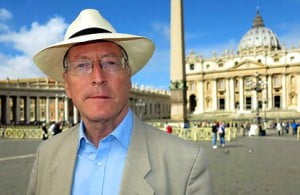 Last Fri I very reluctantly tuned in to sentry Oxford church historian Diarmaid MacCulloch talk well-nigh Sexual practice and the Church. I was reluctant for several reasons. First, don't nosotros talk near this enough already—aren't there more important things to focus on at the moment? (Tonight's 'Kill the Christians', for example, highlighting how the Usa/United kingdom of great britain and northern ireland invasion of Iraq has led directly to the elimination of Christian communities in the region). For another, I was pretty articulate what MacCulloch's calendar was going to be:
I call up religion has got everything appallingly incorrect and it has been terrible for the states in sexual terms.
Sure enough, MacCulloch was evidently very cross at what has happened about attitudes to sex in the W, and he is pretty clear that information technology is all the fault of Christianity.
But I stayed with it for a number of reasons. It was beautifully shot, information technology was informative (in a popular rather than scholarly mode), and MacCulloch certainly has an engaging way of presenting things. Merely more than that, it was intriguing to see the manner MacCulloch wove his argument dorsum and forth, integrating a curious number of contradictions without batting an eyelid on his way to proving his thesis: that the W's obsession with sex comes from Christianity. In fact, the get-go contradiction arose in relation to the thesis itself, from which he immediately stated the the Church'southward current obsession is irrelevant. But if the Westis obsessed with sex, andif it is the Church's fault, should non the Church exist reflecting on this, and wouldn't this reflection have some relevance?
My next question, which was tacitly but not explicitly answered, related to the meaning of MacCulloch'southward thesis: if it is Christianity'southward fault, then which Christianity? I don't hateful hither the question of differing theological traditions, but the relation between the practices through history of those who take chosen themselves 'Christian', including the establishment of the church building, and the original teaching plant in the New Testament. As MacCulloch made clear at several points, for better or worse, Christian attitudes to sex owe very picayune to the Bible. The early (how early?) Christians 'turned sex from pleasance into a sin', he claimed, curiously supposing that sex activity in start century culture was simple and mostly enjoyable. This was in marked contrast to the person of Jesus, who said little most sex (other than siding with one side of the Jewish debate on how strict divorce police should exist) simply rather a lot about forgiveness.
This was set in the context of Jewish concerns almost sex activity, which was important as the means of procreation, the main object of Jewish marriage, in which 'women were there to serve men, i way or another'. I think MacCulloch managed to avoid sounding anti-semitic, but information technology was a shame that in that location was no mention of the contrast between Jewish attitudes to gender roles, marriage and sex activity compared with other cultures in the aboriginal Nearly East. Curious, too, how MacCulloch deployed the language of 'direct and gay' without hinting at the historical anachronism of such terms.
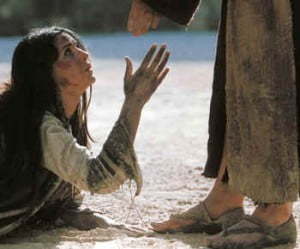 Against this backdrop, Jesus comes out very well. Refreshingly, MacCulloch allows that Jesus 'went his own way' against dominant attitudes both in Jewish and Greek culture. His insistance on monogamy went confronting Jewish practice; his attitude to women was 'revolutionary'; he said nothing about homosexuality, and little near celibacy (except of course that he was celibate himself, which would accept been highly unusual). 'Jesus was not at all representative of what was to get a sexually repressive religion.' So what was the origin of the problem? All eyes turn to the villain of the piece—St Paul!
Yet MacCulloch gave him a mixed printing, adjoining on positive. On the ane hand, Paul appeared to have a negative view about matrimony, since 'It is good for a man non to impact a woman' (1 Cor 7.i), and at times wanted women to remain silent. And nonetheless the same Paul seemed to have a radically egalitarian view of sexual relations in matrimony (1 Cor 7.4), and counted women like Junia amongst the visitor of the apostles (Romans 16.7). What a puzzle this Paul is! It was a shame that MacCulloch here did non consult some better commentaries; information technology is now universally thought that Paul is quoting the Corinthians' own view in 1 Cor 7.one, and if our reading of Paul includes contradictions within a few verses, might the problem not prevarication with our reading rather than Paul'due south writing? The idea that Paul wrote his letters thinking that Jesus was going to return whatsoever 2nd, then did not really consider the consequences of his teaching, is rather discredited.
So, if Paul was not the crusade of the problem, who was? MacCulloch plausibly suggests two sources at ii different points. The first was a cluster of ideas from Greek philosophy: a notion of thrift and asceticism which had a lasting impact on Christianity; Plato'due south radical division betwixt body and soul, in which only the world of the soul mattered, a division which became 'a basic instinct in Christianity'; and the outlook of Aristotle, for whom 'masturbation was murder' since future humans are encapsulated in male semen. It was all this, MacCulloch declaimed, which made the 'early' Christians ignore Paul's more salubrious outlook.
 The 2nd bad influence was the rise of the monastic movement, with its disproportionate emphasis on celibacy in communal life. And where had this come from? Buddhist and Hindu monks in the far due east. This led to the valorising of the celibate life for men and women, and infected attitudes to sex in the growing Christian movement. The rest of the programme traced the impact of this through the growing power of Christianity afterwards the Constantinian settlement, the evolution of Mary as a perpetual virgin (already present in the not-approved Gospel of James, correct), and the thoroughly bad behaviour of Jerome. (My favourite endmost comment related to the seventh century, when all the regulations that grew upwardly meant that there were only 100 days a twelvemonth on which you could take sex. I don't desire to run the danger of inappropriate personal disclosure—only how many married couples accept sex on more days than that?!)
All this turned sex from something about which Jesus had very little to say into an obsession. And who is to blame? Well, contrary to MacCulloch'due south opening statement, the answer isnot 'Christianity'—at to the lowest degree, not in the sense of the teachings of Jesus and Paul and the rest of the New Testament (which is quite clear that Mary did not remain a virgin). If nosotros accept MacCulloch's historical statement seriously, then the problems lay with ideas from Greek philosophy and Buddhist and Hindu instruction, and these actually distorted early on Christian didactics. To be sure, Christianity as a social movement get the vehicle for these distortions beingness transmitted across the known world. But all this suggests an obvious response: to reform the social practices of Christianity, and the impact that a 'repressive sexual morality' has had, by getting back to the teaching of Jesus and Paul.
Why doesn't MacCulloch suggest that as an option? Considering, despite all that he says in the plan, he thinks that the Bible itself is incorrect, and he feels angry most it.
Much of my piece of work is done on a freelance basis. If y'all accept valued this mail, would you lot consideraltruistic £1.20 a month to back up the production of this blog?
If you enjoyed this, practise share it on social media (Facebook or Twitter) using the buttons on the left. Follow me on Twitter @psephizo. Similar my folio on Facebook.
Much of my work is done on a freelance basis. If you accept valued this post, you can brand a single or echo donation through PayPal:
Comments policy: Practiced comments that engage with the content of the postal service, and share in respectful debate, can add real value. Seek first to understand, then to be understood. Make the most charitable construal of the views of others and seek to learn from their perspectives. Don't view debate every bit a conflict to win; address the argument rather than tackling the person.
Source: https://www.psephizo.com/sexuality-2/sex-and-the-church/
0 Response to "Sex and the Church"
Enregistrer un commentaire