How Is Married Couple Embracing Typical of Etruscan Figural Art
 Unknown, The Farewell of Admetus and Alcestis (c 325 BCE), Etruscan red-effigy volute krater found in Vulci, drawing of the original by George Dennis (1848). Original meridian 62 cm, now in Cabinet des Médailles, Bibliothèque nationale de France in Paris. Wikimedia Eatables.
If the origin of Rome and the Romans is rather murky, that of the Etruscans is a total mystery.
Effectually 800 BCE, the fourth dimension of the origin of Greek mythology, and the first of the formation of Rome, when that pot bearing Greek letters entered the ground near Rome, the Etruscans (Latin Tusci) formed every bit a civilization in the Italian region known after them as Tuscany. This was around 5 hundred years after the supposed fall of Troy.
Among several proposals for the origin of the Etruscans, it has been suggested that they may have viewed themselves as descendents of the survivors of Troy, and in that location has been some genetic testify to back up that, and some to contradict it too. At that place is no doubt that, at the time that they synthetic the tombs by which they are now known, these Etruscans were greatly influenced past Greek civilisation, and had earlier been resisting the rise of Rome.
Nonetheless, the pop idea that the Romans obliterated the Etruscans in a wave of genocide is incorrect: from two centuries earlier many of their tombs were congenital, the Etruscans had been steadily integrating with the Romans, and were assimilated (frequently in positions of ability and influence) rather than exterminated.
The tombs of the Etruscans are busy past wonderful paintings, some of the earliest great treasures of European art. Their content, though, is ofttimes strikingly unusual if not downright disturbing, non the sort of thing you'd wait in a family tomb.

The Liberation of Caelius Vibenna (c 340 BCE) shows a convict being freed at the left, and so a series of quite gruesome killings.
The offset step in discovering what these paintings are almost, and how they come up to be there, is to identify the figures shown, and the actions taking place. This is difficult for Etruscan fine art, because, dissimilar the Greeks and Romans, they left virtually no written texts which might help united states, and almost all that nosotros know most them has come from the report of their tombs and grave-goods.
This reads from left to correct as:
- Macstrna (Romanised as Mastarna, who subsequently became Servius Tullius, the legendary sixth king of Rome, and was assassinated in 535 BCE) liberates Caile Vipinas (Caelius Vibenna), a local Etruscan hero;
- the Etruscan hero Larth Ulthes (Lars Voltius) kills Laris Papathnas Velznach (Lars Papatius or Fabatius, a Volsinian);
- the Etruscan hero Rasce (Rascius) kills Pesna Arcmasnas Sveamach, who is Sovanese;
- the Etruscan hero Aule Vipinas (Aulus Vibenna, blood brother of Caile or Caelius) kills someone whose proper name is lost, but was an marry of Rome.
Notation that each Etruscan hero is carefully made to wait the aforementioned, with the same brown pilus and beard, to aid identification.
During the troubled years prior to Macstrna/Mastarna becoming King of Rome, some Etruscans allied themselves with Rome. The killings shown here were role of a surprise set on by loyal Etruscan warriors on those allies of Rome, which the heroes inevitably won. This painting is therefore a celebration of that victory as an accomplishment of loyal Etruscans some ii centuries previously.
Those who fancied even more gore could peek around the corner into the entrance hall of the tomb, where there is a painting of Marce Camitlnas thrusting his sword into a subjugate Cneve Tarchunies Rumach, better known equally Gnaeus Tarquinius, a Roman who may accept been involved in the capture of the brothers Caile and Aule Vipinas (Caelius and Aulus Vibenna).
These paintings appeared on 1 side of the tomb; the other side contained the far older Greek narrative of the sacrifice of the Trojan prisoners, a more than sophisticated painting which was almost certainly copied in office from a Greek original. Other similar images have been found in Italy, such as the Revil Cista shown further below.

Reading this from the left, we have:
- Agamemnon, King of the Mycenaeans and brother-in-law of Helen, who was murdered after his render from Troy;
- the ghost of Patroclus, beloved comrade and friend of Achilles, who was killed in battle by Hector of Troy;
- the winged Etruscan female angel of death, Vanth, whose wings embrace Patroclus and Achilles;
- Achilles, who is leaning forward to behead the Trojan slave at his feet, but was killed before the fall of Troy when Paris shot an pointer into his vulnerable heel;
- the Etruscan death demon, Charun, armed with his hammer;
- Telemonian Ajax, who dies by falling on his own sword at the end of the Trojan War;
- a Trojan slave waiting to be killed;
- Locrian Ajax, who drowns returning from Troy, and is holding another Trojan slave off the right edge of this image.
To understand these, we must go back to the legend of the Fall of Troy.
Troy was a legendary (and probably historical) urban center which ruled over a substantial area of the west of what is at present Turkey. Designed to exist impregnable, it had accumulated considerable riches when the early on Greek civilisation was becoming established. Following the (sick) Judgement of Paris, the winner Aphrodite had promised the Prince of Troy the hand of the most beautiful woman in the world, Helen, who happened to be married to the King of Sparta, Menelaus. Aphrodite then helped Paris seduce and abduct Helen dorsum to Troy.
When Helen was being courted, her unsuccessful suitors formed a pact to return her to Sparta in the issue that anyone dared try to seduce her, and Agamemnon, Male monarch of the Mycenaeans and brother of Menelaus (so brother-in-constabulary of Helen) raised a fleet of more than a yard ships ("was this the face that launched a 1000 ships?") and a swell regular army to attack Troy.
For 10 years, the Mycenaeans (Greeks) and their allies laid siege to Troy, during which many of their heroes were killed in battle. The war was not just long, only very bitter, and the warriors became vengeful, and both sides committed atrocities. At the end of this menstruum Odysseus (Ulysses) had the idea of edifice a wooden horse, into which Greek soldiers would be placed, in gild to get them into the city: the Trojan horse.

The Greeks landed this equus caballus on the shore, and sailed off, patently leaving information technology as a peace offering. In fact they sailed only simply out of sight, and waited.
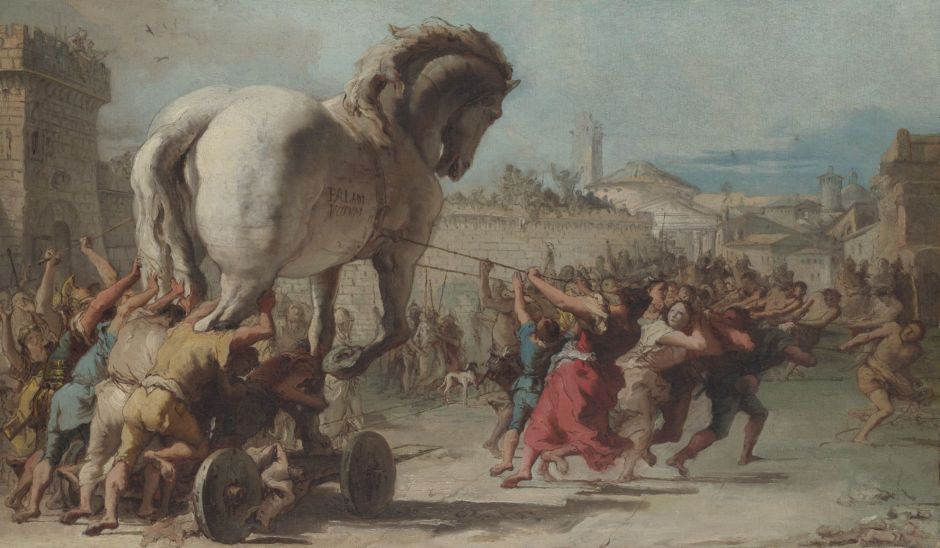
The Trojans hauled the equus caballus up and into the city, dismantling some of their defences to get information technology through the walls. They then went and drank and feasted what they had presumed to be their victory.
While the Trojans were busy getting drunk, the Greek soldiers inside the horse allow themselves out through a trapdoor, lit point bonfires to summon the Greek ships, and opened up the rest of Troy's defences. The Greek army poured into the city as its inhabitants were still recovering from their partying. The city was sacked: all the precious metals and jewels were stripped, the temples desecrated, most of its population murdered, and the buildings were set alight.

Some prisoners were taken. Andromache, widow of the dandy Trojan warrior Hector, was given to Neoptolemus, and Hecuba, Priam'due south widow, to Odysseus. Astyanax, infant son of Hector and Andromache, was killed past being thrown from the urban center's walls.

The dominant aim was to completely destroy the metropolis of Troy and its lands, and to impale almost all of its people. Information technology was calculated genocide.

(Information technology is ordinarily supposed that the fable of Troy is told in Homer'south ballsy Iliad. In fact, that covers only a small fraction of the whole, and does non, for case, even mention the Trojan horse. However the overall legend remains securely embedded in much of European culture – fifty-fifty in our language, and in computer security.)
If this scene makes a direct literary reference, it is to Book 21 of the Iliad:
[Achilles] drew twelve youths alive out of the water, to cede in revenge for Patroklos son of Menoitios. He drew them out like dazed fawns, bound their hands behind them with the belts of their ain shirts, and gave them over to his men to take back to the ships.
There are ii halves or faces to this aboriginal tomb: the Etruscan, celebrating heroes who fought confronting allies of Rome, and the Greek/Trojan, recording the Greek cede of Trojan captives. The story backside the paintings every bit a whole thus depends on whether the Etruscans thought themselves to exist Trojan, or Greek.
If they thought themselves to be Trojan, ane explanation is that the paintings told the story of their survival against the odds, the few who escaped the genocide, and the heroes who resisted against Rome.
If they thought themselves to be Greek (or Greek sympathisers), they could be paying respect to the Greek warriors who ensured the destruction of Troy, just equally their own local heroes had stood upwards and fought against Roman allies.
It all depends on where the Etruscans of that time thought that they had come from. Moreover, nosotros don't know who these paintings were fabricated for, only they were certainly never intended to be seen by the likes of you and I.
You may likewise exist surprised to see a winged angel of decease in the paintings. Vanth, that goddess of death, is one of the more than mutual figures shown in Etruscan tombs.
Vanth and Charun have been identified as the Etruscan deities associated with death. They are often seen equally a couple, accompanying those who accept just died, or are nigh to die. They certainly had their work cut out as Achilles carved his style through the necks of Trojan captives.

The Goodbye of Admetus and Alcestis (c 325 BCE) is an Etruscan vase painting of the Greek myth of Admetos, the King of Pherae, and his wife Alcestis, described in several sources, including Euripides' play Alcestis. When Admetos' fated day of decease came, Apollo intervened to help him – according to Aeschylus, past making the Fates drunkard, so that they agreed to reprieve him from expiry if he could find a substitute. His married woman Alcestis substituted for him.
In this painting, Alcestis is shown making her farewells to her husband, as two versions of Charun (Etruscan, not Greek!) await their victim. Charun on the left wields his trademark hammer, while Charun on the correct holds his feature snakes, but seems to take borrowed Vanth'due south wings.
In Euripides' version, as Alcestis is being taken to the underworld, Admetos decides that he does not wish to live. Heracles intervenes and Alcestis' life is saved. Being a Greek, Euripides has Alcestis beingness taken down by Thanatos, the Greek (and male) version of the Etruscan Vanth, consummate with wings.

This wall painting from the Tomb of the Charuns (or Demons) shows a typical advent of Vanth (left) and Charun (right), either side of a door in an Etruscan tomb, although here the door itself is painted rather than an opening. It is besides interesting to note that Vanth appears to take a halo higher up her head, although given the condition of this painting it is far from certain (and unusual too).

Returning to the original scene of Achilles killing Trojans, the version of Charun shown there is fairly typical, just non stereotypical, in that he does not have snakes with him there. His distinctive hammer or mallet is used to open the commodities on doors, particularly that to the underworld, information technology would appear.

This painted krater was also found in the François Tomb, and shows Charun alone, without a partner Vanth.

Vanth is by no means the only Etruscan deity to come with wings attached, although she is probably the virtually consistently winged. In this wall painting of Typhon, from much later on, around 150 BCE when the Etruscans had been assimilated into the Roman Empire, the Greek monster Typhon has acquired wings in his Etruscan grade.
Although nosotros unremarkably consider Roman deities to be direct descendants of their Greek equivalents, in many cases the Roman deities were more influenced by Etruscan ancestors, who as well may have been the origin of their Roman proper name.
References
Wikipedia on the Trojan State of war.
Wikipedia on the Etruscan Culture.
Wikipedia list of Etruscan deities.
Bryce T (2006) The Trojans and their Neigbours, Routledge. ISBN 978 0 415 34955 0.
de Grummond NT (2006) Etruscan Myth, Sacred History, and Legend, University of Pennsylvania Museum. ISBN 978 1 931707 86 three.
Haynes Southward (2000) Etruscan Civilization. A Cultural History, J Paul Getty Museum. ISBN 978 0 892 36600 2.
Holliday PJ (1993) Narrative Structures in the François Tomb, pp 175-197 in Narrative and Event in Ancient Fine art, ed Holliday PJ, Cambridge Up. ISBN 978 0 521 43013 v.
Lowenstam S (2008) As Witnessed by Images. The Trojan State of war Tradition in Greek and Etruscan Fine art, Johns Hopkins Upwards. ISBN 978 0 8018 8775 8.
Rouveret A (2015) Etruscan and Italic Tomb Painting c 400-200 BC, pp 238-287 in The Cambridge History of Painting in the Classical World, ed Pollitt JJ, Cambridge Upwardly. ISBN 978 0 521 86591 3.
Source: https://eclecticlight.co/2020/08/23/a-history-of-rome-in-paintings-2-etruscans/
0 Response to "How Is Married Couple Embracing Typical of Etruscan Figural Art"
Enregistrer un commentaire